
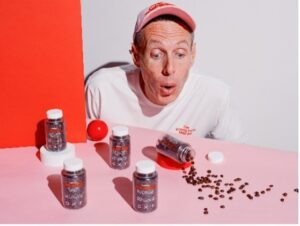
Damien O’Brien Founder
Few people speak about mental health with the raw honesty of Damien O’Brien.
Founder of The Mental Health Association Switzerland (TMHA) and Coffee Foundation. He has transformed life experiences of loss, affliction, and suffering into stories of resilience in one of Switzerland’s most vibrant, disruptive, and socially impactful movements. In this interview, he opens up about vulnerability as a superpower, finding purpose after trauma, design activism, and why Switzerland urgently needs a new mental-health culture.
What inspired the creation of The Mental Health Association Switzerland and Coffee Foundation?
Like so many young people and adults, I grew up in a world where “crazy” felt normal; violence, addiction, and trauma were part of everyday life. Eventually, my own life collapsed, and I hit a rock bottom that ended in hospitalisation. That’s where I was given one of the heaviest stigma labels societies has: “Damien, you’re mentally ill.” I was diagnosed with bipolar disorder.
Despite the cliché, the truth is simple: the very first step is the hardest; it was surrender. Surrendering to my alcoholism, which for years I used as self-medication to numb overwhelming emotions like anxiety, depression, and trauma. And surrendering to that painful diagnosis, accepting it not as a life sentence, but as a turning point. A moment where I realised there had to be some form of goodness in the darkness if I took responsibility for my mental health and my future, instead of being defined by my past. That surrender wasn’t weakness. It was the beginning of rebuilding my life. It forced me to confront everything I had spent years running from, and it ultimately became the foundation for the movement we are building today.
We rarely talk about the other side of mental health because it’s frightening, dark, and painful. I had already lost my mother to suicide and my brother to addiction, but over time, I realised something essential: the biggest killer wasn’t the illness itself, it was the silence, the shame, the stigma that stops not only me, but millions of others, from seeking help.
I wore a mask while bleeding inside, the pressure to isolate, to hide, to pretend, to disappear into society like so many who have no voice in an expert-driven mental-health system.
What makes TMHA different from other mental-health organisations?
TMHA is Switzerland’s first grassroots, lived-experience-led mental-health movement. We focus on prevention, emotional courage, human connection, and helping people open up. The movement is about building the confidence of everyday help-givers, friends, colleagues, and families, because most crises begin long before someone steps into a clinic. Stigma doesn’t break on LinkedIn. It breaks at home, in cafés, in the streets, at work, in the places where people actually talk. One conversation, I believe, can save a life.
Coffee Foundation has become Switzerland’s most awarded mental-health campaign. How did it begin?
We must act; we have a youth mental-health crisis in Switzerland. And it’s not only young people. Mental health has become the leading cause of workplace illness, and suicide is the leading cause of death for young people in this country. If you don’t believe it, try getting an appointment today for your son, daughter, or a family member; the system is overloaded.
You don’t need to be an expert to start a conversation about mental health. We all must become our own experts in looking out for the people around us. We focus on equipping people with the skills to build their mental fitness, the capacity to cope with life’s ups and downs. Our approach is built on three key elements: emotional adaptability, social connectedness, and help-seeking. We call these building your emotional muscles, looking after your village, and never worrying alone.
Your story is a central part of this movement. Can you share more about your personal journey?
I grew up in the housing estates of South Sydney and Mount Druitt, a childhood marked by instability and violence. My mother died by suicide, and my brother from addiction. Later, I faced bipolar disorder, addiction, psychiatric hospitalisation, and the collapse of my own life and career.
Today, I use that history to open doors others keep closed. I use vulnerability, humour, and raw honesty to start conversations that usually stay buried. I am blessed to be both Swiss and Australian and to have seen the cultural revolution around mental health in Australia. I believe Switzerland can change too, toward a culture where we seek help early, where open and honest relationships are normal, and where we feel comfortable expressing ourselves no matter what… so no one has to worry alone.
How has the mission changed since you started?
When we began, the goal was simple: just start the conversation. Today, that small spark has grown into a national stigma-breaking movement. Our mission has evolved from raising awareness to reshaping culture. TMHA now works toward a Switzerland where emotional courage is valued, vulnerability is normal, asking for help is safe, checking in on others is instinctive, and mental illness is recognised as part of being human, not something to hide.
We’ve moved far beyond campaigns or messaging. This is now about building a new social norm: conversations happening in cafés, workplaces, families, schools, and communities before people hit crisis. The mission has become a collective one — empowering everyday people to support each other, strengthening our social fabric, and ensuring no one has to suffer in silence.
TMHA and the Coffee Foundation have gained significant recognition. What impact have you made so far?
I’ve just been invited to speak at TEDx in Geneva in March, and as of this morning, our campaign animation has been viewed more than 150,000 times on YouTube. We’ve become Switzerland’s most internationally recognised mental-health campaign movement.
Our awards include the World Brand Design Society Silver Award, the Brand Impact Awards Bronze, the Givsly Impact Awards NYC Finalist, the Sprudge Design Awards Finalist, and Best Coffee Branding & Design UK 2025.
Our public reach includes interviews on La Télé, RTS, LFM Lausanne, World Radio Switzerland, and Radio Fribourg; coverage from 143.ch, Dargebotene Hand, Branding Asia, and I’m Not A Barista; more than 5,000 TAKE FIVE guides distributed; over 2,000 hours of direct public engagement; and tens of thousands of meaningful conversations at Montreux Noël, Vevey Noël, and Swiss Coffee Connection. Corporate anti-stigma events have been held with Bayer, Audemars Piguet, Medtronic, and others.
Our community impact includes CHF 15,000 donated to youth mental-health and suicide-prevention projects, and strong partnerships with organisations such as 143.ch, the GRAAP Foundation, and local community groups.
What principles guide your work?
Our guiding principle is simple: if it doesn’t benefit the community, we don’t do it. Every decision, every product, every partnership must genuinely help people — not just look good on paper. Integrity isn’t optional for us; it’s the foundation of everything.
Our values shape everything we do:
We’re Real:
Real people sharing real-life experiences — openly, honestly, without filters or façades.
We’re a Village:
Support is a community responsibility. We look after our friends, family, colleagues, and neighbours — because no one should struggle alone.
We’re Vulnerable:
We treat vulnerability as a superpower. Speaking openly about mental health is never weakness — it’s courage, connection, and prevention.
We Disrupt:
Silence is our greatest enemy. We use bold design, street-level engagement, and creative activism to break taboos and make conversations unavoidable.
What obstacles have you faced — and how did you overcome them?
We’ve learned that many actors in the mental-health space engage in what we call mental-health washing — and many corporations are complicit in it. At the same time, several associations and institutions in Switzerland hold deep, ingrained prejudices against anything new, bold, or different. We’ve faced stigma, xenophobia, institutional rejection, lack of funding, and the reality of being underestimated — because lived experience and prevention still hold little value in the traditional mental-health industry.
But we survived, and grew, through courage, creativity, bold design, community support, volunteers, and pure audacity. We don’t play by traditional rules. That’s exactly how we break stigma, because the mental-health crisis doesn’t play by the rules.
What’s next for the movement?
Our goal is to become Switzerland’s leading mental-health movement, not by being the biggest organisation, but by making emotional courage and real conversations a normal part of everyday life. We want to see mental-health discussions happening naturally in cafés, schools, workplaces, homes, and communities across the country.
We plan to expand the TAKE FIVE model nationally, bringing simple, accessible tools to help people start life-changing conversations. We are also developing the Pink Ambulance, a mobile mental-health unit that will bring support, visibility, and connection directly into communities, especially where silence and stigma are strongest.
Another major focus is building a nationwide community of emotional supporters — ordinary people with the courage to check in, listen, and help others long before crisis. And we will continue partnering across education, corporate, health, and public sectors to ensure mental health becomes everyone’s responsibility.
If you’re a superhero, or simply a human being or organisation, who wants to make a difference and join the movement, get in contact with me. Our dream is simple: a world where mental health receives the same care and compassion as physical health. Fight with us — or just CALL US CRAZY!
https://www.coffeefoundation.com/about-coffee-foundation/