
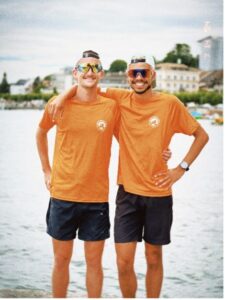
Léo de Riedmatten and Robbie Newton
Léo and Robbie’s journey is a powerful story of endurance, friendship, and the unifying power of sport. Over 26 consecutive days, they ran 26 kilometers each day, covering all 26 cantons of Switzerland. Their challenge wasn’t just about distance, it was about discovery and having a positive impact. Through their efforts, they raised over 26,000 CHF for Sportegration, a non-governmental organisation that works towards the successful and sustainable integration of people from a refugee background into Swiss society through sport.
What inspired you to take on the challenge of running 26 kilometers every day for 26 days?
Léo and I (Robbie) discovered our mutual passion for running during the confinement months of 2020, when going for a run was the only way for us to hang out. Being inspired by the likes of Nick Butter (ran a marathon in every country in the world), Emily Rudlow (ran a half-marathon for 74 consecutive days), or the Hardest Geezer (ran across the entire length of Africa), we wanted to come up with our own challenge. We realised how much there is to discover, experience and enjoy locally, in our own playground, rather than somewhere far away. Spending the better part of a year stuck at home, with no prospects for international travel, gave us the opportunity to explore our homeland like never before, and this is where the idea of a national challenge was born: to run 26km in Switzerland’s 26 cantons in 26 consecutive days.
What was the hardest part of running daily across all 26 cantons, and how did you push through it?
For both of us, the hardest part of Project26 was almost certainly the preparation – both in terms of the logistics and, of course, the physical training. In the months before the project, we were racking up 100-kilometre training weeks, alongside our full-time jobs as well as the often very tedious tasks required to organise such a project. This often meant “double days” – running once in the morning before work and again after work in the evening. As relatively new runners, our training plan for this project represented a huge step-up in what we were used to running and really tested our physical and mental resilience. Deciphering between minor niggles and potentially more significant injuries became an everyday battle. To add to this, Léo was still recovering from a serious and invasive surgery to remove a bone tumour around the hip joint, which added considerable anxiety for both of us as we knew there were no margins for error in the months of physio and strength re-building leading up to the start of the project.
During the project, we found the first 10 days the most difficult as our bodies adjusted to the strain of running 26 kilometers a day, often on very little or poor quality sleep and whilst juggling logistics (train times, accommodation arrangements, event planning, fundraising, etc). After the first 10 days, our bodies seemed to adjust and our recoveries accelerated – the mornings of barely being able to move our legs became fewer and farther between and we eased into our new routine.
Was there a day that really tested you, and how did you get through it?
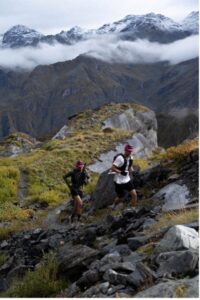
During the project, we averaged about 3 hours per run, some days were quicker (between 2-2.5 hours) and others closer to 4-5 hours. However, in Appenzell Innerrhoden (day 6) the run took us over 7 hours as it included over 2,000 vertical meters. As this was near the beginning of the project, we also hadn’t quite got used to the aches and pains either, so we started this run with heavy legs, which only got heavier as the run went on.
Having just completed the third big climb in the run, both starving, we spotted a small restaurant on the mountain and determined that we had earnt a quick lunch break. As soon as we sat down, we looked at our watches hoping to see that we’d made good progress: “Time elapsed: 2.5 hours; Distance: 7km” – it was going to be a long and tough day.
As was often the case on this project and likely the reason we managed to complete it all, the harder things got, the sillier we got. We spent the next 5 hours after lunch intermittently switching between bursts of manic laughter – the highest of highs – and complete silence, as we both individually questioned what we had signed up for.
Ultimately, it was our friendship and a sense of being in it together which got us out of the many ruts we got ourselves into on this trip. Every evening seeing the support we were receiving on social media and the donations flowing in also really helped push us on.
Did doing this challenge change the way you see your own limits or abilities?
Absolutely. One of the biggest discoveries from this Project was the huge gap between what we perceived our physical and mental limits to be, and what they actually were. There were countless moments during the project where we questioned, either due to injuries, nausea, lack of sleep, or exhaustion, whether we would be able to complete this challenge and every time we prevailed with a stronger sense of determination.
Separate from the physical takeaways of this project, it also required us to put ourselves out there – whether that be by promoting the project on social media and at events, or by reaching out to sponsors, hotels, and donors seeking their support. In many ways this was another significant part of the challenge, particularly for one of us (*cough* Robbie *cough*), who was less accustomed to being in the public eye.
How did the journey influence your perspective on endurance, teamwork, and personal growth?
I think as we mentioned above, when we first came up with the idea for this challenge we were both terrified and I (Léo) really didn’t think it would be achievable. But, by putting in the work and the effort over a long period of time (about 3 years between when we first had the idea and when we completed the Project) and incrementally progressing, you end up achieving things you thought were out of your reach. For both of us it was the project with the longest horizon we’d ever worked towards, and we couldn’t have done it without each other. We moved in together as a way to encourage each other and also to hold each other accountable. So, many a day one of us would wake up exhausted and unmotivated but hearing the other one lacing up their shoes was the positive peer-pressure we needed to get moving. On the personal growth side, I think we both built a lot of self-confidence and experience in being very far outside our comfort zones whether that be physical or mental, and because on top of that we reached our running goal and our fundraising goal.
How did it feel knowing your runs were helping Sportegration and supporting refugees?
We are both firm believers in the unique power of sport to break down social barriers and unite people from all walks of life, so when we found out about Sportegration and met with their staff and beneficiaries, it was instantly a perfect match. We wanted the project to be as inclusive as possible, so all our events were open for people to join and on a number of our runs we were joined by members of Sportegration’s run club. Running side by side and hearing first-hand how Sportegration has changed lives was very powerful and definitely helped spur us on throughout the project.
On a number of occasions, we didn’t speak the same language as the people we were running with (one particular example of running with two runners from Afghanistan in Bern springs to mind…), but through a combination of hand signals and broken English we made it work. It was a powerful reminder of how effective sport can be at bringing people together, regardless of language, or indeed culture, religion, or any other means of differentiating people.
In short, although the world can feel increasingly divided (often by design), this project reminded us of our fundamental unity. It served as a powerful reminder of not buying into the divisive narratives regularly amplified by political actors and the media. Instead we hope that this project was able to shine a spotlight on our shared humanity and the incredible work done by people and organisations like Sportegration. We wanted to focus on positivity rather than negativity, there’s plenty enough of that going around.
What’s next for you both after completing PROJECT26?
Watch this space… but rest assured, many exciting projects are in the works. Beyond pushing ourselves, we loved the community aspect of this project and we’d love to do more in that space.
Credit @Clement Simon
Watch the full documentary:
PROJECT26 Full Documentary
Follow on social media:
Instagram: Rob & Léo’s Journey