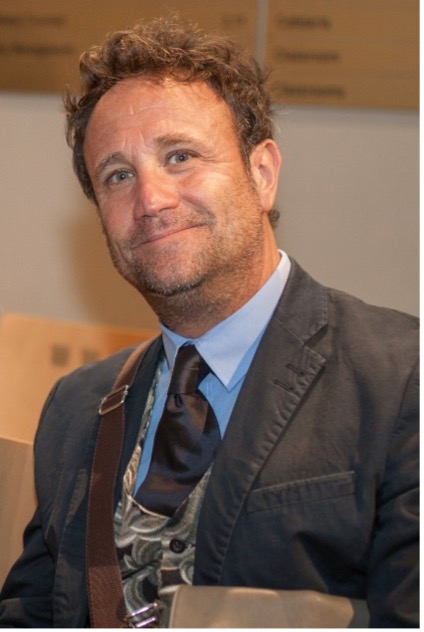


Michael Brosowski, an Australian teacher, founded Blue Dragon Children’s Foundation after moving to Hanoi in 2002. While teaching, he began helping street children with lessons and life skills, offering guidance and support. In 2004, he officially launched Blue Dragon as a charity. A year later, an encounter with a trafficked boy shifted the organisation’s focus to rescuing victims of human trafficking and slavery. Since then, under Michael’s leadership, Blue Dragon has grown into a leading NGO in Vietnam, supporting thousands of survivors, advocating for stronger protections, and earning international recognition, including being named a CNN Hero and receiving the Order of Australia.
The name ‘Blue Dragon’ is really striking. Can you tell us the story behind it?
Our name and logo are packed with symbolism. The dragon is a creature of good luck and power in Southeast Asia; and Vietnam’s shape, tilted sideways, resembles a dragon like ours. The blue of our name is for the blue skies and seas, which always remind me of freedom and hope. Putting these images together, the name of our organisation represents all that we want Vietnamese children to have.
Can you share what inspired you to start Blue Dragon and dedicate your life to helping children and adults vulnerable to trafficking?
In moving to Vietnam, my intention was never to start a charity. But in meeting young people who so desperately wanted to escape poverty and hardship so that they could lead fulfilling lives… how could I do anything other than help?
Was there a defining moment or experience that made you realise this work was necessary?
I moved to Vietnam to live in Ho Chi Minh City, in the south of the country, but ended up at the other end of the country teaching at a university in Hanoi. It was only meant to be temporary, so when the time came for me to return to the south, I had to consider what it meant for the children and families I had been helping.
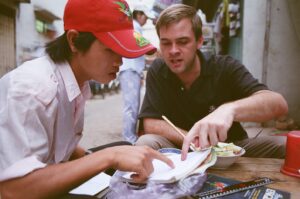
At that time, some of my university students and I were running classes for street kids and we had gotten to know them well. I remember a powerful moment of realising that, had I been born in Vietnam, I almost certainly would have been a street kid – just like the children we were helping. With that insight, I knew that I could not leave.
How would you describe Blue Dragon’s mission?
There’s our long-term purpose, and there’s the mission we are working on right now.
Blue Dragon’s purpose will always be to protect children from exploitation; and we can go one step further to say that we don’t want children only to be safe, we want them to thrive.
Over the years since we started, we’ve faced different situations in which children have been exploited or at some kind of risk. For some years, the major issue was children in sweatshops. We put a significant effort into dealing with that, and now it is only in rare cases that Vietnamese children might be found working in a sweatshop. At another time, we were highly focused on protecting street boys from sexual exploitation. We worked with the government to introduce a law which criminalised the abuse of boys, and now our involvement is much less because the police are able to deal with the cases that arise.
So we turned to our current mission: how to end human trafficking. We’ve rescued more than 2,000 people from slavery since we started, and this has taught us a great deal about what makes people vulnerable to traffickers. By working directly with vulnerable people, we’ve developed systems and solutions that greatly reduce the risk of people being trafficked. Right now, we’re focused on scaling this work up and aiming to hand it over to the government so that they can implement these solutions nationally.
Could you walk us through what happens when someone is rescued — and how Blue Dragon helps them rebuild their lives?
We rescue people in response to a call for help. That may be from a Vietnamese person who is in slavery in Cambodia or Myanmar; or it may be from a family member. First – and quickly – we need to investigate to ensure the story is true and narrow down where they may be. From there, we develop a plan to help them escape and bring them home. We keep specific details confidential, but I can say that we do not use violence or aggression, and we do not pay bribes. Every rescue is a little different, but it’s always about helping them safely and quietly slip away and then bringing them back to Vietnam. The traffickers don’t even know that we were there.
The moment we reach Vietnam, the rescued person’s first step is to make a statement to police. Blue Dragon’s lawyers are there at the border to help and from there they have a choice. They can come to stay with us for counselling, accommodation, training and employment, or they can return directly to their own home. Whatever they choose, we support them – we can go with them to their village if they wish, or we can just pay the bus fare. All of the decisions are in the hands of the survivor. We have psychologists and social workers to help, and we don’t have a single program that the rescued person can join; instead, we tailor our assistance to what they need. For some, it may be a few days of shelter and a health check. For others, it may be several years of counselling and schooling.
Mental health is such an important part of recovery. How does Blue Dragon support the emotional and psychological wellbeing of survivors?
This is a vital question! We have a team of psychologists who work hand in hand with excellent social workers. We offer individual therapy, family counselling and even group therapy. Blue Dragon’s psychologists use a range of methods; we’ve found great success with EMDR but also apply more traditional techniques such as Cognitive Behavioural Therapy. Alongside these we utilise aromatherapy, art therapy and healing activities in nature. Our view of wellbeing is quite holistic.
What are some of the biggest challenges your team faces?
There are really two great challenges for us.
First, the need never ends. As we grow more skilled and more effective, more people know of us and ask for our help. We do our best to serve everyone who needs us and at the same time we seek to solve the overall problems we are dealing with – like implementing systems that keep people safe from trafficking.
And second, the context is permanently dynamic. The tricks that traffickers use today may be different tomorrow. Street children may gather in one common location this week, and next week they are scattered around the city. So we as an organisation must be highly agile, ready to change at any moment.
How important is working with communities, governments, and local partners to prevent trafficking before it happens?
When Blue Dragon started, I often saw collaboration as an impediment to success. We could go so much faster if we just did things ourselves. But it has become clear that through partnerships we can scale our work far greater, and it will last much longer. In reality, today Blue Dragon has a mix of direct work, where we have our own people out on the streets assisting homeless children and responding to calls from people in slavery; and at the same time we are building partnerships with others for the long term.
Is there a story that really sticks with you, a person whose life was transformed through Blue Dragon?
Some of the Blue Dragon staff are people who we once helped – adults who, as children, were trafficked or were street kids. One of our staff is the very first person we rescued from trafficking. He was 13 years old and his family had been tricked into believing the traffickers were offering a training program. Instead they made him work on the streets of Ho Chi Minh City, selling flowers to tourists. At that time, he had never been to school before. Today he’s one of our staff, working in a rural community to keep children safe from trafficking. He has a family of his own and they’re doing wonderfully well. This seemed unimaginable when I met the boy 20 years ago.
What are your hopes for Blue Dragon over the next few years, and the legacy you hope to leave?
I think about this question often. If for any reason Blue Dragon were to suddenly stop right this moment, we already have an incredible legacy. In addition to the thousands of children and young adults we’ve helped to transform their lives, we can see that Vietnam as a country is a safer, healthier place for children because of the laws we have changed and the social development we have led.
But there’s still that one big issue that we wish to solve: How to end human trafficking. In fact, the solutions are becoming clear and we are forming a very strong picture of what needs to be done. As we build up the evidence and clarify the systems that are needed, this information will be helpful not only for Vietnam, but for any country that wishes to protect its children. And that will be a wonderful legacy to leave.
Links
Our website: www.bluedragon.org
Blog: lifeisalongstory.com